Septic Tank Smell in the House: Find the Source in 15 Minutes
Quick answer
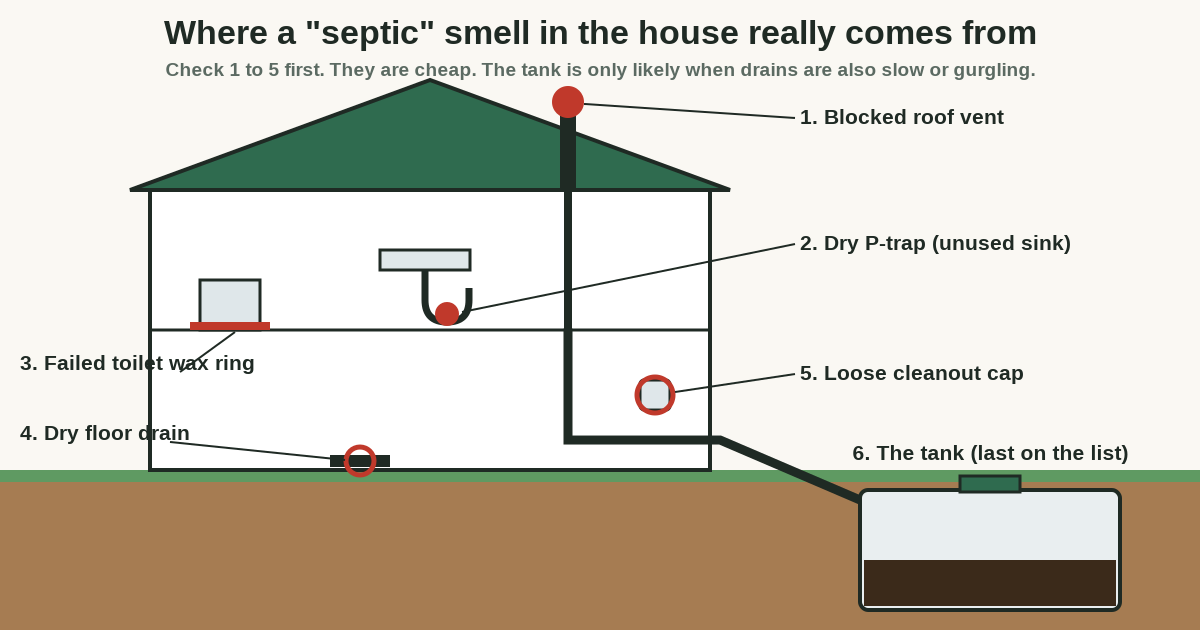
Most indoor “septic” smells come from the plumbing, not the tank. Before you spend money on a pumper, check the five cheap causes first:
- A dry P-trap in an unused drain or floor drain
- A failed toilet wax ring
- A blocked or frozen roof vent stack
- A loose cleanout cap, or a dry trap in the basement
- Biofilm built up in a sink or shower drain
The tank is the likely cause only when the smell is strongest outside, over the tank or drain field, or when it comes with slow drains and gurgling. If you have those signs, skip ahead to the section on when it is the tank.
Why the smell shows up indoors
Every drain has a bend of standing water called a trap, which keeps sewer gas out of the room. A vent through the roof lets gas escape and air in. If a trap dries out, a seal fails or the vent clogs, gas finds its way inside.
The 15-minute check
Work through these steps in order.
1. Sniff test, room by room (3 minutes)
Walk through each bathroom, the kitchen, the laundry area and the basement. Close doors and windows first, since drafts move the smell around. Note where it is strongest.
2. Is it strongest near one fixture? (1 minute)
A smell that peaks at one sink, tub, toilet or drain points to a local problem. A smell that fills the whole house points to the vent, the cleanout or the tank.
3. Run water into every drain (3 minutes)
Run each faucet for 30 seconds. Do the same for every shower and tub, including guest rooms nobody uses. Then pour a quart of water into each floor drain, laundry sink and basement fixture. Flush every toilet once.
Sniff again in ten minutes. If the smell faded, you likely had a dry trap.
4. Check behind the toilet base (3 minutes)
Sit on or push gently against each toilet. Any rocking means the seal may be loose. Look at the floor around the base for stains, soft flooring, or a gap in the caulk. Water or a sewer smell near the base points to the wax ring.
5. Look at the roof vent from the ground (2 minutes)
Stand back from the house and find the vent pipe or pipes sticking out of the roof. Look for a bird nest, leaves, snow or frost closing the opening. In cold weather a vent can frost over to a hole the size of a pencil.
6. Check the cleanout cap (3 minutes)
Most septic homes have a capped cleanout pipe, either in the basement or crawl space, or just outside near the foundation. Check that the cap is present, hand-tight and not cracked. A loose or missing cap lets gas leak right into the room.
Symptom table
Use this as a quick lookup once you know where the smell is strongest.
| Symptom | Most likely cause | Fix | Cost |
|---|---|---|---|
| Smell in one bathroom only | Dry trap, biofilm in the drain, or wax ring | Run water, clean the drain, check the toilet base | $0 to $20 DIY; $150 to $300 if the wax ring needs a plumber |
| Smell near a floor drain or unused basement fixture | Dry P-trap | Pour in water, add a tablespoon of mineral oil | About $0 to $5 |
| Smell after heavy rain or wind | Blocked vent, saturated drain field, or wind pushing gas back down the vent | Check and clear the vent; if the yard is soggy, get the system inspected | $0 DIY for the vent; $150 to $400 for an inspection |
| Smell everywhere plus gurgling and slow drains | Full tank, clogged outlet or failing drain field | Cut water use and call a pumper | Pumping often runs a few hundred dollars; repairs vary widely |
| Smell outside over the tank | Cracked lid or riser, full tank or surfacing effluent | Keep people and pets away, call a septic company | Inspection and lid or riser work vary by site |
| Smell from the washing machine standpipe | Dry or missing trap, or biofilm in the standpipe | Pour in water, clean the standpipe, check that a trap exists | $0 to $30 DIY; plumber if a trap must be added |
Costs are rough US ranges. Get a quote before any work.
The five cheap causes, and the fix for each
Dry P-trap
This is the most common cause. A floor drain, guest shower or basement sink that sits unused for weeks lets its trap water evaporate. Furnaces speed that up in winter.
Fix: Pour about a quart of water down the drain. For a drain you rarely use, add a tablespoon of mineral oil afterward. The oil floats on top of the water and slows evaporation. Repeat monthly.
Failed toilet wax ring
The wax ring seals the toilet to the drain flange in the floor. When it fails, you may notice a smell near the base, a toilet that rocks, or damp flooring.
Fix: Replace the ring. The part costs about $20, and the job means shutting off the water, lifting the toilet, scraping off the old wax and setting the toilet back down on a new ring. If you do not want to lift a toilet, a plumber typically charges $150 to $300.
Blocked or frozen roof vent stack
If the vent is blocked, drains can pull water out of the traps as they empty. That creates gurgling and lets gas into the room.
Fix: Clear leaves, ice or a bird nest. Never work on a wet or icy roof. A plumber can snake the vent from the roof for a modest fee.
Loose cleanout cap or dry trap in the basement
A cleanout cap that has worked loose, or a cracked cap, leaks gas where the pipe enters the house. A basement floor drain next to it may also be dry.
Fix: Tighten the cap by hand or replace it. Fill the nearby floor drain with water at the same time.
Biofilm in a sink or shower drain
A slimy film of bacteria and organic matter builds on the inside of the drain and can smell like sewage or a swamp, even though nothing is wrong with your septic system.
Fix: Pull the stopper and scrub the drain wall with a stiff brush. Then use an enzyme drain cleaner according to the label. Avoid bleach: it does not remove the film well, and heavy use can harm the bacteria your tank relies on.
When it is the tank
Some smells really do start in the septic system. Signs include a smell that is strongest outdoors, slow drains in the whole house, gurgling in several fixtures, wet or spongy ground over the drain field, and sewage backing up in the lowest drain.
Common tank-side causes:
- A full tank. Solids build up, and the system struggles to separate waste. See how often to pump a septic tank for typical schedules.
- A failed baffle. The baffle keeps solids from flowing out to the drain field. When one breaks, solids can escape and clog the field.
- A saturated drain field. If the soil cannot absorb water, effluent surfaces or backs up.
- A cracked lid or riser. Gas leaks through the opening and you smell it in the yard.
What to do:
- Stop heavy water use. Skip laundry, long showers and the dishwasher until you get an answer.
- Call a septic pumper or septic company for an inspection.
- Do not open the tank lid yourself.
Safety note: hydrogen sulfide
Septic gas contains hydrogen sulfide, the rotten-egg smell. At low levels it is just unpleasant. At high concentrations it is toxic, and it deadens your sense of smell, so the odor can seem to disappear exactly when the danger is rising. Tanks can also hold too little oxygen to breathe. People die in septic tanks every year, including people who tried to rescue someone else.
If you smell strong gas and feel dizzy, get a headache, feel sick or have trouble breathing, leave the building and call 911 or your local emergency number from outside. Do not go back in to check.
Odor additives: what they can and cannot do
Two kinds of products show up in this conversation: oxygen-releasing additives and bacterial additives. On a working system, they can reduce tank odor within days for some households. They do nothing for a dry trap, a blocked vent or a bad wax ring, because those are not tank problems.
Septifix is one product in this category. You can read the Septifix review for details. Rid-X is the supermarket alternative. Neither replaces pumping or fixes a failing drain field. Fix the plumbing causes first.
Preventing the smell from coming back
- Run water in unused drains monthly. Set a reminder.
- Keep pumping records. Note the date and what the pumper found.
- No bleach floods. Small amounts of household cleaner are fine. Large doses can disturb the bacteria in the tank.
- Keep vents clear. Look at the roof vent from the ground each fall and after storms, and trim branches that hang over it.
FAQ
Why does my house smell like septic only at night? Air moves differently when it cools. Cooler outdoor air can settle, and a house can pull gas in through a dry trap or a leaking cap. Check traps and the vent first.
Can a septic smell make you sick? A brief whiff is usually just unpleasant. Strong or lasting exposure can cause headaches, nausea and eye or throat irritation, and high levels of hydrogen sulfide are dangerous. If you feel unwell, get fresh air and call for help.
Why does it smell when it rains? Rain can saturate the drain field so gas and effluent have nowhere to go. Falling pressure and wind can also push gas back down a vent. If it happens only in storms, inspect the vent and the yard.
Why does my bathroom smell like sewage after a shower? Running water can push air and gas past a weak trap seal, or stir up biofilm in the drain. A dry or failing wax ring can also release gas when the floor is damp. Clean the drain, and check the toilet base.
Does a smell mean my tank is full? Not necessarily. A smell is often a plumbing issue. A full tank usually shows up as slow drains, gurgling, backups or soggy ground, not just an odor.
Should I call a plumber or a septic company? Start with a plumber if the smell is inside one room or near a toilet, drain or vent. Call a septic company if drains are slow everywhere, the yard smells, the ground is wet, or sewage backs up.