Septifix vs Rid-X (2026): Which Septic Treatment Should You Buy?
Disclosure: this page has affiliate links. If you buy through one we earn a commission at no extra cost to you. We say plainly what the product does and does not do. How we work.
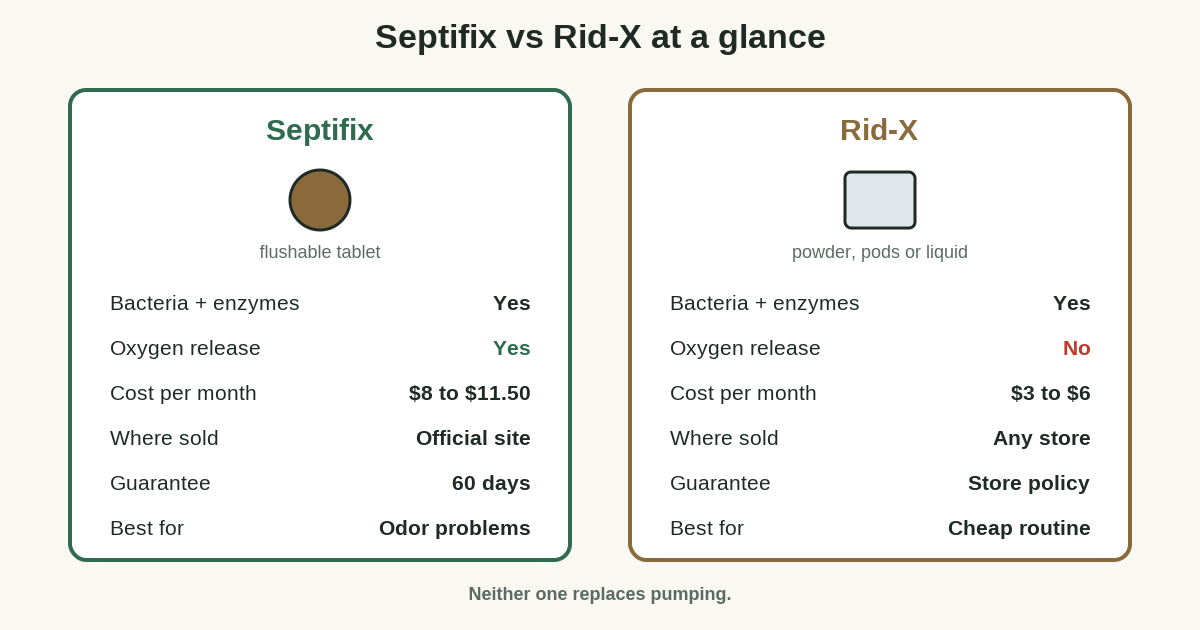
Quick answer
If your tank is healthy and you just want a cheap monthly habit, buy Rid-X. It costs roughly $3 to $6 a month, you can pick it up at any supermarket or hardware store, and it gives you bacteria plus four enzymes. For routine maintenance, that is enough for most homeowners.
If your main complaint is odor and you are willing to pay about double, Septifix is the one with a different angle: a flushable tablet that, according to the maker, adds an oxygen-releasing compound. We cover the details in our full Septifix review. Neither product fixes a full tank or a failed drain field. Those need a pumper or a septic professional, not an additive.
Side-by-side comparison
| Septifix | Rid-X | |
|---|---|---|
| Form | 55 g flushable tablet | Powder, gel pods, liquid |
| Bacteria | Maker says 14 strains of aerobic bacteria | Bacteria blend |
| Enzymes | Not listed as a feature | Cellulase, lipase, protease, amylase |
| Oxygen release | Yes, per the maker | No |
| pH buffer | Sodium carbonate, per the maker | Not a stated feature |
| Dose | 3 tablets the first month, then 1 a month | One monthly dose (follow the label for your form) |
| Monthly cost | About $8 to $11.50 | Roughly $3 to $6 |
| Where sold | Official site only, via ClickBank | Supermarkets and hardware stores |
| Guarantee | 60-day money-back, enforced by ClickBank | Return policy of the store you bought from |
Prices change, so treat these as a guide and not a quote.
What is actually in each one
I have not opened a lab report on either product, and I am not going to pretend otherwise. What follows is what the labels and makers say, plus some plain reasoning.
Septifix
The maker says each 55 g tablet contains three things:
- 14 strains of aerobic bacteria. Aerobic means they work in the presence of oxygen.
- A sodium carbonate pH buffer. The idea is to keep the tank from drifting too acidic.
- An oxygen-releasing compound, meant to give those aerobic bacteria something to work with.
Those are the maker’s claims. I cannot confirm how much oxygen is released, or how much of it matters inside a tank that is mostly a sealed, low-oxygen environment. The oxygen angle is the product’s whole pitch, so it is worth knowing that the evidence for it comes from the company selling it.
Rid-X
Rid-X combines bacteria with four enzymes:
- Cellulase, which targets plant fiber and paper.
- Lipase, which targets fats and grease.
- Protease, which targets proteins.
- Amylase, which targets starches.
It does not release oxygen. It comes as a powder, gel pods or a liquid, so you can choose whatever is least annoying to use. Like Septifix, it is not a repair product. It is a maintenance habit.
How you use each one
Septifix dosing
Start with 3 tablets the first month, then 1 tablet a month. You flush them. One thing to know up front: because of that heavier first month, a “6-month” box lasts about 4 months. Plan your reorder with that in mind, or you will run out earlier than the label suggests.
Rid-X dosing
Follow the label for the form you buy. It is a monthly routine, and the powder, pods and liquid all go in through a toilet or drain. Because it is sold everywhere, running out is never a problem.
What to avoid with both
Neither product works well if you keep killing the bacteria you are paying to add. Common culprits:
- Bleach, especially heavy or frequent use in laundry and cleaning.
- Antibacterial soap.
- Drain cleaner.
Bleach, antibacterial soap and drain cleaner kill tank bacteria. If you use them often, an additive is just paying to replace what you destroyed.
And do not treat either product as a substitute for pumping. Extension services and pumpers generally say a tank should be pumped every 3 to 5 years, depending on tank size and how many people live in the house. Our guide on how often to pump a septic tank goes through the factors.
Cost over a year
Here is the arithmetic, using the numbers above.
Rid-X: about $3 to $6 a month, times 12, is roughly $36 to $72 a year.
Septifix: the monthly cost runs from $8 to $11.50 depending on the package. The plans work out like this:
| Package | Price | Shipping | Approx. per month |
|---|---|---|---|
| 6 months | $69 | Extra | $11.50 |
| 12 months | $118 | Free | About $9.85 |
| 18 months | $147 | Free | About $8.15 |
It is a one-time payment with no subscription. Over a year, Septifix lands at roughly $96 to $138.
A fair way to compare: the gap is somewhere between $24 and $102 a year, depending on which products and packages you pick. If you are on the 6-month plan, remember the 3-tablet start means the box covers about 4 months, so your real monthly cost on that plan runs higher than the headline number. The larger packages soften that effect, since the extra start-up tablets are spread over more months.
If you decide Septifix fits, you can check the current Septifix price before you commit, since package prices and shipping can change.
Which one for which problem
Odor
This is where Septifix makes its case. Septic odor can come from many things: a dry trap, a clogged vent, a full tank, or a tank low on active bacteria. If you have ruled out the simple plumbing causes and the smell is mild, the oxygen angle is the one thing Septifix offers that Rid-X does not. I would not call it proven, since the claim is the maker’s. But if odor is the problem and you are happy to pay more, it is the logical thing to try.
Strong, persistent smells, especially near the tank or drain field, point to something an additive will not fix. Call a professional.
Slow drains
For a slow drain, the first stop is the drain itself: a hair clog, a grease buildup, a bad trap. Add a regular enzyme-and-bacteria product like Rid-X for ongoing maintenance, and give it a few weeks. If every drain in the house is slow, or water backs up, that is a tank or drain field problem, not a maintenance-additive problem.
A tank overdue for pumping
Neither. If you do not know when your tank was last pumped, or it has been more than 5 years, call a pumper. An additive cannot remove built-up solids. Sludge and scum accumulate whatever you pour in, and the only fix is pumping. Spend the money there first.
Complaints people have about each
I have not tested either product, so this section is about patterns, not results.
Septifix:
- Price. At $8 to $11.50 a month, it is a bigger commitment than the supermarket option.
- Only sold through the official site, so you cannot grab one on a bad day at the store.
- The “6-month” box covers about 4 months. People who miss this run out early.
- The upfront payment, even with a 60-day money-back guarantee handled through ClickBank, is more than most people pay for an additive in one go.
- Hard to verify the oxygen claim, since the information comes from the maker.
Rid-X:
- Some people question whether any additive is needed on a healthy, regularly pumped tank.
- No oxygen release, so it does not address the aerobic angle.
- Results can feel invisible, which is normal for maintenance, but makes it hard to know it is doing anything.
- Returns depend on the store, not the maker.
A point that applies to both: septic additives as a category have a mixed reputation among pumpers and extension services. Many say a normally used tank gets what it needs from household waste. That is not a reason to avoid them, but it is a reason not to expect miracles.
Verdict
For most homeowners, Rid-X is the sensible default. It is cheap, easy to find, and fine for routine upkeep. If you want a monthly habit and nothing more, spend the $3 to $6 and move on.
Septifix is for a narrower person: someone whose main concern is odor, who has already ruled out the simple causes, and who is happy to pay roughly double for the oxygen-releasing, pH-buffered approach. If that is you, read our full Septifix review and then check the current Septifix price for the package that fits.
Whichever you choose, the rules do not change. Pump on schedule, go easy on bleach, antibacterial soap and drain cleaner, and call a pro when the problem looks bigger than a tablet or a scoop.
FAQ
Can I use Septifix and Rid-X together? There is no reason to. They do overlapping jobs, and doubling up just doubles the cost. Pick one and give it a few months.
Does either product replace pumping? No. Pumpers and extension services say to pump every 3 to 5 years depending on tank size and household. Additives do not remove accumulated solids.
Is Septifix worth double the price of Rid-X? Only if odor is your main issue and you want the oxygen-release approach the maker describes. For routine maintenance on a healthy tank, the cheaper option does the job.
What if I try Septifix and do not like it? It comes with a 60-day money-back guarantee, enforced by ClickBank. Read the refund terms at checkout and keep your order details. Rid-X returns follow the store where you bought it.
What can I do to help any additive work? Stop killing the bacteria. Cut back on bleach, antibacterial soap and drain cleaner, spread out laundry loads, and keep grease and wipes out of the drain. Those habits matter more than which product you choose.