How Often to Pump a Septic Tank (With a Simple Table by Tank Size and Household)
Quick answer
Most households should pump a septic tank every 3 to 5 years. The EPA recommends having the system inspected at least every 3 years and pumped as needed, which is typically every 3 to 5 years.
That range is a starting point, not a rule. Your own number depends on three things: how big the tank is, how many people live in the house, and how much water and waste goes down the drain.
- A garbage disposal adds a lot of solids, so it shortens the interval.
- A large family in a small tank may need a pump-out every 1 to 2 years.
- A couple living in a large tank can often stretch past 5 years, as long as an inspection confirms it.
Pumping interval by tank size and household size
The table below uses the widely published Penn State Extension estimates. It shows the approximate years between pump-outs for a household that does not use a garbage disposal.
| Tank size | 1 person | 2 people | 3 people | 4 people | 5 people | 6 people |
|---|---|---|---|---|---|---|
| 750 gallons | 9.1 | 4.2 | 2.6 | 1.8 | 1.3 | 1.0 |
| 1,000 gallons | 12.4 | 5.9 | 3.7 | 2.6 | 2.0 | 1.5 |
| 1,250 gallons | 15.6 | 7.5 | 4.8 | 3.4 | 2.6 | 2.0 |
| 1,500 gallons | 18.9 | 9.1 | 5.9 | 4.2 | 3.3 | 2.6 |
Treat these as estimates, not promises. They assume normal use and no disposal. A garbage disposal roughly halves each number, so a 4-person home with a 1,000-gallon tank and a disposal should plan on about 1.3 years instead of 2.6.
Two cautions when reading the table:
- Long intervals for one or two people on a big tank look attractive, but do not go 15 years without a look. Baffles, filters and pumps can fail even when the tank is nearly empty of solids.
The real rule: measure the sludge and scum
The table is a calendar guess. The better rule is based on what is actually inside the tank.
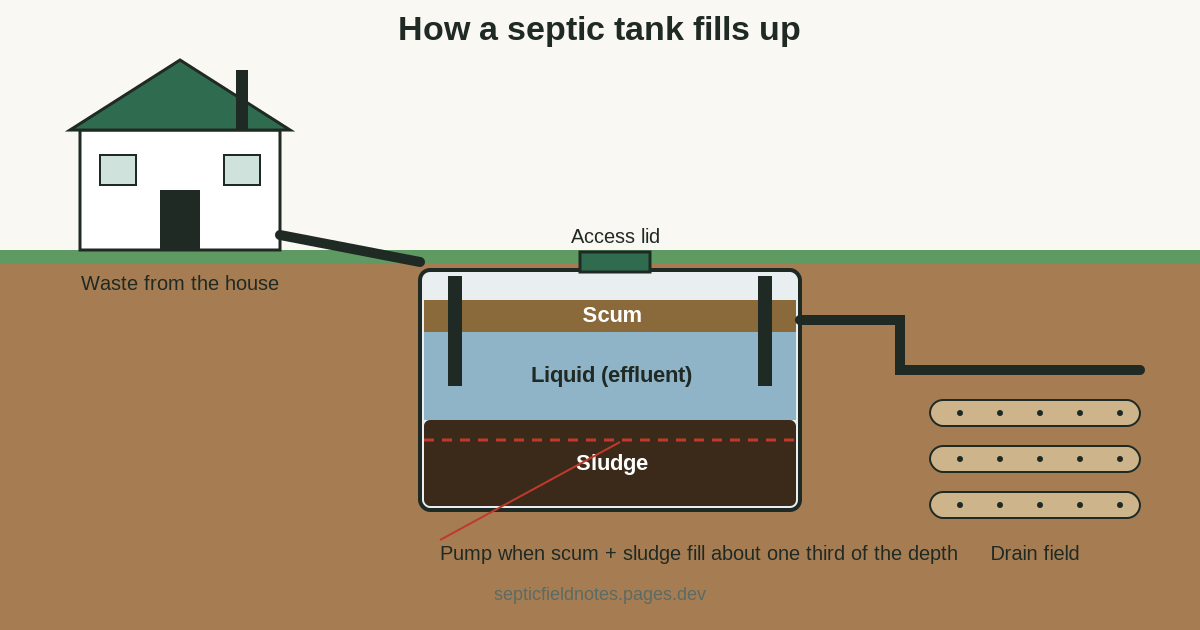
A septic tank separates waste into three layers. Heavy solids settle into sludge at the bottom. Fats and light solids float as scum at the top. Clear liquid sits in the middle and flows out to the drain field.
Pump when either of these is true:
- The sludge and scum layers together take up about one third of the liquid depth of the tank.
- Scum is within 6 inches of the bottom of the outlet baffle, or sludge is within 12 inches of it.
Once solids get that high, they start to leave the tank with the liquid and head for the drain field.
A pumper or septic inspector measures this with a tool called a sludge judge. It is a clear tube that goes down through the access lid and pulls up a sample showing each layer. The reading takes a few minutes.
This is why a periodic inspection is worth the money. If you have a 2-person household in a 1,500-gallon tank and the inspector reports a thin sludge layer after 4 years, you can safely wait. If the same tank is half full of solids, you pump now and shorten the schedule.
Signs your septic tank is overdue
Do not wait for symptoms. By the time they show up, solids may already be reaching the drain field. Still, know what to look for:
- Slow drains throughout the house. One slow sink is usually a local clog. Several slow fixtures at once points to the septic system.
- Gurgling sounds in pipes when you flush or run water.
- Sewage smell inside the house or over the tank or drain field.
- Wet, soggy or unusually lush green grass over the drain field, especially in dry weather.
- Backups in the lowest drain in the house, such as a basement floor drain or shower.
Sewage in the house is an emergency. Stop using water and call a pumper right away.
One note on smell: an odor alone does not prove the tank is full. A dry floor drain trap, a dried-out sink trap or a blocked plumbing vent can cause the same smell. Pour water into rarely used drains first, and check that the roof vent is clear. If the smell stays, get the tank inspected.
What pumping costs in 2025 and 2026
A standard pump-out costs about $300 to $600 in most of the US. Costs run higher in expensive metro areas and for large tanks. Prices usually go by tank size, with a base fee plus an extra charge for gallons beyond a set amount.
| Service | Typical cost |
|---|---|
| Standard pump-out (1,000 to 1,250 gallon tank, easy access) | $300 to $600 |
| Pump-out with a full inspection | $400 to $800 |
| Emergency, weekend or after-hours call | $500 to $1,000 or more |
| Locating and digging up a buried lid | $100 to $400 extra |
These are ranges, not quotes. Large tanks of 2,000 gallons or more, long hose runs, steep driveways and winter conditions all push the price up. Call two or three local companies and ask what is included. Some charge extra for the inspection, for cleaning the effluent filter, or for each gallon over a limit.
What happens if you never pump
If solids build up past the baffles, they flow out of the tank and into the drain field. The soil in the drain field can clog with that material, and once it clogs, it rarely recovers.
A failed drain field leads to sewage backing up into the house or surfacing in the yard. That is a health hazard and often a code violation.
Replacing a drain field costs $5,000 to $20,000 or more, depending on soil, system type and local rules.
Compare that with a pump-out every few years at a few hundred dollars. Skipping pumping is the most expensive way to save money on a septic system.
How to stretch the interval honestly
You cannot skip pumping, but you can reduce how fast the tank fills and protect the drain field. These habits help:
- Spread out laundry. Do one or two loads a day rather than six on Saturday. A flood of water pushes solids out before they settle.
- Fix leaks and running toilets. A leaking toilet can send hundreds of gallons a day to the tank.
- Skip the garbage disposal, or use it less. Compost food scraps instead. Disposals add a lot of solids.
- Flush only toilet paper and human waste. No wipes, even those labeled flushable. No feminine products, dental floss, cat litter or paper towels.
- Keep grease out of the drain. Wipe pans with a paper towel and throw it away.
- Go easy on bleach and strong antibacterial products. Normal household amounts are fine. Heavy use can upset the bacteria the tank depends on.
- Keep records. Write down every pump date so you are not guessing.
Do additives let you skip pumping?
No. No product replaces pumping.
Bacterial additives such as Septifix and Rid-X are sold with the promise of keeping the tank healthy. On a tank that is already working normally, they may help with odor and with breaking down some scum. Beyond that, the evidence is thin. A healthy tank already contains the bacteria it needs, and they come from the waste itself.
What no additive does is dissolve the inorganic sludge that settles at the bottom, such as grit, soap residue and other solids that do not break down. That material has to be pumped out. If you want to read more about one product, see our Septifix review.
Keep a pumping log
A simple log makes future decisions easy. Keep it in a folder with your permit and tank diagram, and pass it on to the next owner. Each time the tank is serviced, write down:
- The date
- The company name and phone number
- The tank size they found and the number of compartments
- The measured sludge and scum depth, if they took a reading
- What the pumper said about the baffles, the effluent filter, the lids and the pump (if you have one)
Measured sludge depth is the most useful entry. If the layer was thin after 4 years, you can stretch the next interval. If it was close to the limit, shorten it.
Septic pumping FAQ
Can I pump my own septic tank?
No. Septage is regulated waste, and in most states only licensed haulers can remove and dispose of it. It also contains dangerous gases and pathogens, and tank gases have killed people who entered or leaned over open tanks. Hire a licensed pumper.
Does a 2-person household really need pumping every 3 years?
Not always. The table shows a 2-person household with a 1,000-gallon tank at about 6 years, and a 1,500-gallon tank at about 9. But those are estimates. Many local health departments and the EPA advise an inspection every 3 years. If the sludge measurement is low, you can wait longer.
How do I find my tank?
Start with your permit, the as-built drawing or the county health department records. The tank is usually 10 to 25 feet from the house, along the line of the main sewer pipe. You can also follow the pipe from where it leaves the basement or crawl space, or probe the ground with a thin metal rod. A pumper can locate it with a probe or electronic locator, usually for a fee.
Should the tank be pumped before selling a house?
It is a good idea, and in some areas the law requires an inspection at sale. A recent pump-out and inspection report shows buyers the system is in good order. Check local rules, since requirements vary by county and state.
Is it bad to pump too often?
It is not harmful, just wasteful. Pumping removes the bacteria-rich sludge, and a freshly pumped tank needs a short time to rebuild. Some pumpers leave a little behind for this reason. Pumping every year on a lightly used tank costs money without much benefit.
What is the difference between pumping and cleaning?
In practice, the terms are used loosely. Pumping removes the liquid, scum and most of the sludge. Cleaning usually means pumping plus washing down the walls, checking the baffles and cleaning the effluent filter. A good service does the second even if it is called a pump-out. Ask what is included before you book.